Wednesday, May 27, 2009

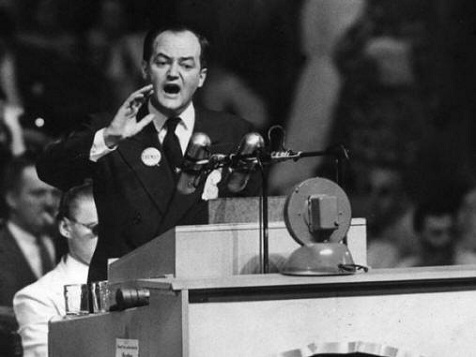
Landmark Civil Rights Speech by Hubert H. Humphrey at the 1948 Democratic National Convention

The late Hubert H. Humphrey, vice-president from 1964-1968 and U.S. senator from Minnesota, was born 98 years ago today on May 27, 1911. His reputation as a national leader in the Democratic party was built initially from this landmark civil rights speech at the Democratic National Convention on July 14, 1948.


Mr. Chairman, fellow Democrats, fellow Americans:

I realize that in speaking in behalf of the minority report on civil rights as presented by Congressman DeMiller of Wisconsin that I'm dealing with a charged issue -- with an issue which has been confused by emotionalism on all sides of the fence. I realize that there are here today friends and colleagues of mine, many of them, who feel just as deeply and keenly as I do about this issue and who are yet in complete disagreement with me.

My respect and admiration for these men and their views was great when I came to this convention. It is now far greater because of the sincerity, the courtesy, and the forthrightness with which many of them have argued in our prolonged discussions in the platform committee.

Because of this very great respect -- and because of my profound belief that we have a challenging task to do here -- because good conscience, decent morality, demands it -- I feel I must rise at this time to support a report -- the minority report -- a report that spells out our democracy, a report that the people of this country can and will understand, and a report that they will enthusiastically acclaim on the great issue of civil rights.

Now let me say this at the outset that this proposal is made for no single region. Our proposal is made for no single class, for no single racial or religious group in mind. All of the regions of this country, all of the states have shared in our precious heritage of American freedom. All the states and all the regions have seen at least some of the infringements of that freedom -- all people -- get this -- all people, white and black, all groups, all racial groups have been the victims at time[s] in this nation of -- let me say -- vicious discrimination.

The masterly statement of our keynote speaker, the distinguished United States Senator from Kentucky, Alben Barkley, made that point with great force. Speaking of the founder of our Party, Thomas Jefferson, he said this, and I quote from Alben Barkley:

He did not proclaim that all the white, or the black, or the red, or the yellow men are equal; that all Christian or Jewish men are equal; that all Protestant and Catholic men are equal; that all rich and poor men are equal; that all good and bad men are equal. What he declared was that all men are equal; and the equality which he proclaimed was the equality in the right to enjoy the blessings of free government in which they may participate and to which they have given their support.

Now these words of Senator Barkley’s are appropriate to this convention -- appropriate to this convention of the oldest, the most truly progressive political party in America. From the time of Thomas Jefferson, the time when that immortal American doctrine of individual rights, under just and fairly administered laws, the Democratic Party has tried hard to secure expanding freedoms for all citizens. Oh, yes, I know, other political parties may have talked more about civil rights, but the Democratic party has surely done more about civil rights.

We have made progress -- we've made great progress in every part of this country. We’ve made great progress in the South; we’ve made it in the West, in the North, and in the East. But we must now focus the direction of that progress towards the -- towards the realization of a full program of civil rights to all. This convention must set out more specifically the direction in which our Party efforts are to go.

We can be proud that we can be guided by the courageous trail blazing of two great Democratic Presidents. We can be proud of the fact that our great and beloved immortal leader Franklin Roosevelt gave us guidance. And we be proud of the fact -- we can be proud of the fact that Harry Truman has had the courage to give to the people of America the new emancipation proclamation.

It seems to me -- It seems to me that the Democratic Party needs to to make definite pledges of the kinds suggested in the minority report, to maintain the trust and the confidence placed in it by the people of all races and all sections of this country. Sure, we’re here as Democrats. But my good friends, we’re here as Americans; we’re here as the believers in the principle and the ideology of democracy, and I firmly believe that as men concerned with our country’s future, we must specify in our platform the guarantees which we have mentioned in the minority report.

Yes, this is far more than a Party matter. Every citizen in this country has a stake in the emergence of the United States as a leader in the free world. That world is being challenged by the world of slavery. For us to play our part effectively, we must be in a morally sound position.

We can’t use a double standard -- There’s no room for double standards in American politics -- for measuring our own and other people’s policies. Our demands for democratic practices in other lands will be no more effective than the guarantee of those practices in our own country.

Friends, delegates, I do not believe that there can be any compromise on the guarantees of the civil rights which we have mentioned in the minority report. In spite of my desire for unanimous agreement on the entire platform, in spite of my desire to see everybody here in honest and unanimous agreement, there are some matters which I think must be stated clearly and without qualification. There can be no hedging -- the newspaper headlines are wrong. There will be no hedging, and there will be no watering down -- if you please -- of the instruments and the principles of the civil-rights program.

My friends, to those who say that we are rushing this issue of civil rights, I say to them we are 172 years late. To those who say that this civil-rights program is an infringement on states’ rights, I say this: The time has arrived in America for the Democratic Party to get out of the shadow of states' rights and to walk forthrightly into the bright sunshine of human rights. People -- human beings -- this is the issue of the 20th century. People of all kinds -- all sorts of people -- and these people are looking to America for leadership, and they’re looking to America for precept and example.

My good friends, my fellow Democrats, I ask you for a calm consideration of our historic opportunity. Let us do forget the evil passions and the blindness of the past. In these times of world economic, political, and spiritual -- above all spiritual crisis, we cannot and we must not turn from the path so plainly before us. That path has already lead us through many valleys of the shadow of death. And now is the time to recall those who were left on that path of American freedom.

For all of us here, for the millions who have sent us, for the whole two billion members of the human family, our land is now, more than ever before, the last best hope on earth. And I know that we can, and I know that we shall began [sic] here the fuller and richer realization of that hope, that promise of a land where all men are truly free and equal, and each man uses his freedom and equality wisely well.

My good friends, I ask my Party, I ask the Democratic Party, to march down the high road of progressive democracy. I ask this convention to say in unmistakable terms that we proudly hail, and we courageously support, our President and leader Harry Truman in his great fight for civil rights in America!

Tuesday, May 26, 2009

A Latina Judge’s Voice on the Bench: "I am a 'Newyorkrican.'"

Federal Appeals Court Judge Sonia Sotomayor, 54, was nominated today by President Barack Obama to fill the U.S. Supreme Court vacancy created by the retirement of Justice David Souter.

The following is the text of Sotomayor's speech in the 2001 Judge Mario G. Olmos Memorial Lecture at the University of California, Berkeley, School of Law.


Judge Reynoso, thank you for that lovely introduction. I am humbled to be speaking behind a man who has contributed so much to the Hispanic community. I am also grateful to have such kind words said about me.

I am delighted to be here. It is nice to escape my hometown for just a little bit. It is also nice to say hello to old friends who are in the audience, to rekindle contact with old acquaintances and to make new friends among those of you in the audience. It is particularly heart warming to me to be attending a conference to which I was invited by a Latina law school friend, Rachel Moran, who is now an accomplished and widely respected legal scholar. I warn Latinos in this room: Latinas are making a lot of progress in the old-boy network.

I am also deeply honored to have been asked to deliver the annual Judge Mario G. Olmos lecture. I am joining a remarkable group of prior speakers who have given this lecture. I hope what I speak about today continues to promote the legacy of that man whose commitment to public service and abiding dedication to promoting equality and justice for all people inspired this memorial lecture and the conference that will follow. I thank Judge Olmos' widow Mary Louise's family, her son and the judge's many friends for hosting me. And for the privilege you have bestowed on me in honoring the memory of a very special person. If I and the many people of this conference can accomplish a fraction of what Judge Olmos did in his short but extraordinary life we and our respective communities will be infinitely better.

I intend tonight to touch upon the themes that this conference will be discussing this weekend and to talk to you about my Latina identity, where it came from, and the influence I perceive it has on my presence on the bench.

Who am I? I am a "Newyorkrican." For those of you on the West Coast who do not know what that term means: I am a born and bred New Yorker of Puerto Rican-born parents who came to the states during World War II.

Like many other immigrants to this great land, my parents came because of poverty and to attempt to find and secure a better life for themselves and the family that they hoped to have. They largely succeeded. For that, my brother and I are very grateful. The story of that success is what made me and what makes me the Latina that I am. The Latina side of my identity was forged and closely nurtured by my family through our shared experiences and traditions.

For me, a very special part of my being Latina is the mucho platos de arroz, gandoles y pernir - rice, beans and pork - that I have eaten at countless family holidays and special events. My Latina identity also includes, because of my particularly adventurous taste buds, morcilla, -- pig intestines, patitas de cerdo con garbanzo -- pigs' feet with beans, and la lengua y orejas de cuchifrito, pigs' tongue and ears. I bet the Mexican-Americans in this room are thinking that Puerto Ricans have unusual food tastes. Some of us, like me, do. Part of my Latina identity is the sound of merengue at all our family parties and the heart wrenching Spanish love songs that we enjoy. It is the memory of Saturday afternoon at the movies with my aunt and cousins watching Cantinflas, who is not Puerto Rican, but who was an icon Spanish comedian on par with Abbot and Costello of my generation. My Latina soul was nourished as I visited and played at my grandmother's house with my cousins and extended family. They were my friends as I grew up. Being a Latina child was watching the adults playing dominos on Saturday night and us kids playing loteria, bingo, with my grandmother calling out the numbers which we marked on our cards with chick peas.

Now, does any one of these things make me a Latina? Obviously not because each of our Carribean and Latin American communities has their own unique food and different traditions at the holidays. I only learned about tacos in college from my Mexican-American roommate. Being a Latina in America also does not mean speaking Spanish. I happen to speak it fairly well. But my brother, only three years younger, like too many of us educated here, barely speaks it. Most of us born and bred here, speak it very poorly.

If I had pursued my career in my undergraduate history major, I would likely provide you with a very academic description of what being a Latino or Latina means. For example, I could define Latinos as those peoples and cultures populated or colonized by Spain who maintained or adopted Spanish or Spanish Creole as their language of communication. You can tell that I have been very well educated. That antiseptic description however, does not really explain the appeal of morcilla - pig's intestine - to an American born child. It does not provide an adequate explanation of why individuals like us, many of whom are born in this completely different American culture, still identify so strongly with those communities in which our parents were born and raised.

America has a deeply confused image of itself that is in perpetual tension. We are a nation that takes pride in our ethnic diversity, recognizing its importance in shaping our society and in adding richness to its existence. Yet, we simultaneously insist that we can and must function and live in a race and color-blind way that ignore these very differences that in other contexts we laud. That tension between "the melting pot and the salad bowl" -- a recently popular metaphor used to described New York's diversity - is being hotly debated today in national discussions about affirmative action. Many of us struggle with this tension and attempt to maintain and promote our cultural and ethnic identities in a society that is often ambivalent about how to deal with its differences. In this time of great debate we must remember that it is not political struggles that create a Latino or Latina identity. I became a Latina by the way I love and the way I live my life. My family showed me by their example how wonderful and vibrant life is and how wonderful and magical it is to have a Latina soul. They taught me to love being a Puerto Riqueña and to love America and value its lesson that great things could be achieved if one works hard for it. But achieving success here is no easy accomplishment for Latinos or Latinas, and although that struggle did not and does not create a Latina identity, it does inspire how I live my life.

I was born in the year 1954. That year was the fateful year in which Brown v. Board of Education was decided. When I was eight, in 1961, the first Latino, the wonderful Judge Reynaldo Garza, was appointed to the federal bench, an event we are celebrating at this conference. When I finished law school in 1979, there were no women judges on the Supreme Court or on the highest court of my home state, New York. There was then only one Afro-American Supreme Court Justice and then and now no Latino or Latina justices on our highest court. Now in the last twenty plus years of my professional life, I have seen a quantum leap in the representation of women and Latinos in the legal profession and particularly in the judiciary. In addition to the appointment of the first female United States Attorney General, Janet Reno, we have seen the appointment of two female justices to the Supreme Court and two female justices to the New York Court of Appeals, the highest court of my home state. One of those judges is the Chief Judge and the other is a Puerto Riqueña, like I am. As of today, women sit on the highest courts of almost all of the states and of the territories, including Puerto Rico. One Supreme Court, that of Minnesota, had a majority of women justices for a period of time.

As of September 1, 2001, the federal judiciary consisting of Supreme, Circuit and District Court Judges was about 22% women. In 1992, nearly ten years ago, when I was first appointed a District Court Judge, the percentage of women in the total federal judiciary was only 13%. Now, the growth of Latino representation is somewhat less favorable. As of today we have, as I noted earlier, no Supreme Court justices, and we have only 10 out of 147 active Circuit Court judges and 30 out of 587 active district court judges. Those numbers are grossly below our proportion of the population. As recently as 1965, however, the federal bench had only three women serving and only one Latino judge. So changes are happening, although in some areas, very slowly. These figures and appointments are heartwarming. Nevertheless, much still remains to happen.

Let us not forget that between the appointments of Justice Sandra Day O'Connor in 1981 and Justice Ginsburg in 1992, eleven years passed. Similarly, between Justice Kaye's initial appointment as an Associate Judge to the New York Court of Appeals in 1983, and Justice Ciparick's appointment in 1993, ten years elapsed. Almost nine years later, we are waiting for a third appointment of a woman to both the Supreme Court and the New York Court of Appeals and of a second minority, male or female, preferably Hispanic, to the Supreme Court. In 1992 when I joined the bench, there were still two out of 13 circuit courts and about 53 out of 92 district courts in which no women sat. At the beginning of September of 2001, there are women sitting in all 13 circuit courts. The First, Fifth, Eighth and Federal Circuits each have only one female judge, however, out of a combined total number of 48 judges. There are still nearly 37 district courts with no women judges at all. For women of color the statistics are more sobering. As of September 20, 1998, of the then 195 circuit court judges only two were African-American women and two Hispanic women. Of the 641 district court judges only twelve were African-American women and eleven Hispanic women. African-American women comprise only 1.56% of the federal judiciary and Hispanic-American women comprise only 1%. No African-American, male or female, sits today on the Fourth or Federal circuits. And no Hispanics, male or female, sit on the Fourth, Sixth, Seventh, Eighth, District of Columbia or Federal Circuits.

Sort of shocking, isn't it? This is the year 2002. We have a long way to go. Unfortunately, there are some very deep storm warnings we must keep in mind. In at least the last five years the majority of nominated judges the Senate delayed more than one year before confirming or never confirming were women or minorities. I need not remind this audience that Judge Paez of your home Circuit, the Ninth Circuit, has had the dubious distinction of having had his confirmation delayed the longest in Senate history. These figures demonstrate that there is a real and continuing need for Latino and Latina organizations and community groups throughout the country to exist and to continue their efforts of promoting women and men of all colors in their pursuit for equality in the judicial system.

This weekend's conference, illustrated by its name, is bound to examine issues that I hope will identify the efforts and solutions that will assist our communities. The focus of my speech tonight, however, is not about the struggle to get us where we are and where we need to go but instead to discuss with you what it all will mean to have more women and people of color on the bench. The statistics I have been talking about provide a base from which to discuss a question which one of my former colleagues on the Southern District bench, Judge Miriam Cederbaum, raised when speaking about women on the federal bench. Her question was: What do the history and statistics mean? In her speech, Judge Cederbaum expressed her belief that the number of women and by direct inference people of color on the bench, was still statistically insignificant and that therefore we could not draw valid scientific conclusions from the acts of so few people over such a short period of time. Yet, we do have women and people of color in more significant numbers on the bench and no one can or should ignore pondering what that will mean or not mean in the development of the law. Now, I cannot and do not claim this issue as personally my own. In recent years there has been an explosion of research and writing in this area. On one of the panels tomorrow, you will hear the Latino perspective in this debate.

For those of you interested in the gender perspective on this issue, I commend to you a wonderful compilation of articles published on the subject in Vol. 77 of the Judicature, the Journal of the American Judicature Society of November-December 1993. It is on Westlaw/Lexis and I assume the students and academics in this room can find it.

Now Judge Cedarbaum expresses concern with any analysis of women and presumably again people of color on the bench, which begins and presumably ends with the conclusion that women or minorities are different from men generally. She sees danger in presuming that judging should be gender or anything else based. She rightly points out that the perception of the differences between men and women is what led to many paternalistic laws and to the denial to women of the right to vote because we were described then "as not capable of reasoning or thinking logically" but instead of "acting intuitively." I am quoting adjectives that were bandied around famously during the suffragettes' movement.

While recognizing the potential effect of individual experiences on perception, Judge Cedarbaum nevertheless believes that judges must transcend their personal sympathies and prejudices and aspire to achieve a greater degree of fairness and integrity based on the reason of law. Although I agree with and attempt to work toward Judge Cedarbaum's aspiration, I wonder whether achieving that goal is possible in all or even in most cases. And I wonder whether by ignoring our differences as women or men of color we do a disservice both to the law and society. Whatever the reasons why we may have different perspectives, either as some theorists suggest because of our cultural experiences or as others postulate because we have basic differences in logic and reasoning, are in many respects a small part of a larger practical question we as women and minority judges in society in general must address. I accept the thesis of a law school classmate, Professor Steven Carter of Yale Law School, in his affirmative action book that in any group of human beings there is a diversity of opinion because there is both a diversity of experiences and of thought. Thus, as noted by another Yale Law School Professor -- I did graduate from there and I am not really biased except that they seem to be doing a lot of writing in that area - Professor Judith Resnik says that there is not a single voice of feminism, not a feminist approach but many who are exploring the possible ways of being that are distinct from those structured in a world dominated by the power and words of men. Thus, feminist theories of judging are in the midst of creation and are not and perhaps will never aspire to be as solidified as the established legal doctrines of judging can sometimes appear to be.

That same point can be made with respect to people of color. No one person, judge or nominee will speak in a female or people of color voice. I need not remind you that Justice Clarence Thomas represents a part but not the whole of African-American thought on many subjects. Yet, because I accept the proposition that, as Judge Resnik describes it, "to judge is an exercise of power" and because as, another former law school classmate, Professor Martha Minnow of Harvard Law School, states "there is no objective stance but only a series of perspectives - no neutrality, no escape from choice in judging," I further accept that our experiences as women and people of color affect our decisions. The aspiration to impartiality is just that--it's an aspiration because it denies the fact that we are by our experiences making different choices than others. Not all women or people of color, in all or some circumstances or indeed in any particular case or circumstance but enough people of color in enough cases, will make a difference in the process of judging. The Minnesota Supreme Court has given an example of this. As reported by Judge Patricia Wald formerly of the D.C. Circuit Court, three women on the Minnesota Court with two men dissenting agreed to grant a protective order against a father's visitation rights when the father abused his child. The Judicature Journal has at least two excellent studies on how women on the courts of appeal and state supreme courts have tended to vote more often than their male counterpart to uphold women's claims in sex discrimination cases and criminal defendants' claims in search and seizure cases. As recognized by legal scholars, whatever the reason, not one woman or person of color in any one position but as a group we will have an effect on the development of the law and on judging.

In our private conversations, Judge Cedarbaum has pointed out to me that seminal decisions in race and sex discrimination cases have come from Supreme Courts composed exclusively of white males. I agree that this is significant but I also choose to emphasize that the people who argued those cases before the Supreme Court which changed the legal landscape ultimately were largely people of color and women. I recall that Justice Thurgood Marshall, Judge Connie Baker Motley, the first black woman appointed to the federal bench, and others of the NAACP argued Brown v. Board of Education. Similarly, Justice Ginsburg, with other women attorneys, was instrumental in advocating and convincing the Court that equality of work required equality in terms and conditions of employment.

Whether born from experience or inherent physiological or cultural differences, a possibility I abhor less or discount less than my colleague Judge Cedarbaum, our gender and national origins may and will make a difference in our judging. Justice O'Connor has often been cited as saying that a wise old man and wise old woman will reach the same conclusion in deciding cases. I am not so sure Justice O'Connor is the author of that line since Professor Resnik attributes that line to Supreme Court Justice Coyle. I am also not so sure that I agree with the statement. First, as Professor Martha Minnow has noted, there can never be a universal definition of wise. Second, I would hope that a wise Latina woman with the richness of her experiences would more often than not reach a better conclusion than a white male who hasn't lived that life.

Let us not forget that wise men like Oliver Wendell Holmes and Justice Cardozo voted on cases which upheld both sex and race discrimination in our society. Until 1972, no Supreme Court case ever upheld the claim of a woman in a gender discrimination case. I, like Professor Carter, believe that we should not be so myopic as to believe that others of different experiences or backgrounds are incapable of understanding the values and needs of people from a different group. Many are so capable. As Judge Cedarbaum pointed out to me, nine white men on the Supreme Court in the past have done so on many occasions and on many issues including Brown.

However, to understand takes time and effort, something that not all people are willing to give. For others, their experiences limit their ability to understand the experiences of others. Other simply do not care. Hence, one must accept the proposition that a difference there will be by the presence of women and people of color on the bench. Personal experiences affect the facts that judges choose to see. My hope is that I will take the good from my experiences and extrapolate them further into areas with which I am unfamiliar. I simply do not know exactly what that difference will be in my judging. But I accept there will be some based on my gender and my Latina heritage.

I also hope that by raising the question today of what difference having more Latinos and Latinas on the bench will make will start your own evaluation. For people of color and women lawyers, what does and should being an ethnic minority mean in your lawyering? For men lawyers, what areas in your experiences and attitudes do you need to work on to make you capable of reaching those great moments of enlightenment which other men in different circumstances have been able to reach. For all of us, how do change the facts that in every task force study of gender and race bias in the courts, women and people of color, lawyers and judges alike, report in significantly higher percentages than white men that their gender and race has shaped their careers, from hiring, retention to promotion and that a statistically significant number of women and minority lawyers and judges, both alike, have experienced bias in the courtroom?

Each day on the bench I learn something new about the judicial process and about being a professional Latina woman in a world that sometimes looks at me with suspicion. I am reminded each day that I render decisions that affect people concretely and that I owe them constant and complete vigilance in checking my assumptions, presumptions and perspectives and ensuring that to the extent that my limited abilities and capabilities permit me, that I reevaluate them and change as circumstances and cases before me requires. I can and do aspire to be greater than the sum total of my experiences but I accept my limitations. I willingly accept that we who judge must not deny the differences resulting from experience and heritage but attempt, as the Supreme Court suggests, continuously to judge when those opinions, sympathies and prejudices are appropriate.

There is always a danger embedded in relative morality, but since judging is a series of choices that we must make, that I am forced to make, I hope that I can make them by informing myself on the questions I must not avoid asking and continuously pondering. We, I mean all of us in this room, must continue individually and in voices united in organizations that have supported this conference, to think about these questions and to figure out how we go about creating the opportunity for there to be more women and people of color on the bench so we can finally have statistically significant numbers to measure the differences we will and are making.

I am delighted to have been here tonight and extend once again my deepest gratitude to all of you for listening and letting me share my reflections on being a Latina voice on the bench. Thank you.

Monday, May 25, 2009

The Incommunicable Experience of War: 1895 Memorial Day Speech by Oliver Wendell Holmes Jr.


Holmes delivered this speech on Memorial Day, May 30, 1895, to the graduating class of Harvard University.

Any day in Washington Street, when the throng is greatest and busiest, you may see a blind man playing a flute. I suppose that some one hears him. Perhaps also my pipe may reach the heart of some passer in the crowd.

I once heard a man say, "Where Vanderbilt sits, there is the head of the table. I teach my son to be rich." He said what many think. For although the generation born about 1840, and now governing the world, has fought two at least of the greatest wars in history, and has witnessed others, war is out of fashion, and the man who commands attention of his fellows is the man of wealth. Commerce is the great power. The aspirations of the world are those of commerce. Moralists and philosophers, following its lead, declare that war is wicked, foolish, and soon to disappear.

The society for which many philanthropists, labor reformers, and men of fashion unite in longing is one in which they may be comfortable and may shine without much trouble or any danger. The unfortunately growing hatred of the poor for the rich seems to me to rest on the belief that money is the main thing (a belief in which the poor have been encouraged by the rich), more than on any other grievance. Most of my hearers would rather that their daughters or their sisters should marry a son of one of the great rich families than a regular army officer, were he as beautiful, brave, and gifted as Sir William Napier. I have heard the question asked whether our war was worth fighting, after all. There are many, poor and rich, who think that love of country is an old wife's tale, to be replaced by interest in a labor union, or, under the name of cosmopolitanism, by a rootless self-seeking search for a place where the most enjoyment may be had at the least cost.

Meantime we have learned the doctrine that evil means pain, and the revolt aginst pain in all its forms has grown more and more marked. From societies for the prevention of cruelty to animals up to socialism, we express in numberless ways the notion that suffering is a wrong which can be and ought to be prevented, and a whole literature of sympathy has sprung into being which points out in story and in verse how hard it is to be wounded in the battle of life, how terrible, how unjust it is that any one should fail.

Even science has had its part in the tendencies which we observe. It has shaken established religion in the minds of very many. It has pursued analysis until at last this thrilling world of colors and passions and sounds has seemed fatally to resolve itself into one vast network of vibrations endlessly weaving an aimless web, and the rainbow flush of cathedral windows, which once to enraptured eyes appeared the very smile of God, fades slowly out into the pale irony of the void.

And yet from vast orchestras still comes the music of mighty symphonies. Our painters even now are spreading along the walls of our Library glowing symbols of mysteries still real, and the hardly silenced cannon of the East proclaim once more that combat and pain still are the portion of man. For my own part, I believe that the struggle for life is the order of the world, at which it is vain to repine. I can imagine the burden changed in the way it is to be borne, but I cannot imagine that it ever will be lifted from men's backs. I can imagine a future in which science shall have passed from the combative to the dogmatic stage, and shall have gained such catholic acceptance that it shall take control of life, and condemn at once with instant execution what now is left for nature to destroy. But we are far from such a future, and we cannot stop to amuse or to terrify ourselves with dreams. Now, at least, and perhaps as long as man dwells upon the globe, his destiny is battle, and he has to take the chances of war. If it is our business to fight, the book for the army is a war-song, not a hospital-sketch. It is not well for soldiers to think much about wounds. Sooner or later we shall fall; but meantime it is for us to fix our eyes upon the point to be stormed, and to get there if we can.

Behind every scheme to make the world over, lies the question, What kind of world do you want? The ideals of the past for men have been drawn from war, as those for women have been drawn from motherhood. For all our prophecies, I doubt if we are ready to give up our inheritance. Who is there who would not like to be thought a gentleman? Yet what has that name been built on but the soldier's choice of honor rather than life? To be a soldier or descended from soldiers, in time of peace to be ready to give one's life rather than suffer disgrace, that is what the word has meant; and if we try to claim it at less cost than a splendid carelessness for life, we are trying to steal the good will without the responsibilities of the place. We will not dispute about tastes. The man of the future may want something different. But who of us could endure a world, although cut up into five-acre lots, and having no man upon it who was not well fed and well housed, without the divine folly of honor, without the senseless passion for knowledge outreaching the flaming bounds of the possible, without ideals the essence of which is that they can never be achieved? I do not know what is true. I do not know the meaning of the universe. But in the midst of doubt, in the collapse of creeds, there is one thing I do not doubt, that no man who lives in the same world with most of us can doubt, and that is that the faith is true and adorable which leads a soldier to throw away his life in obedience to a blindly accepted duty, in a cause which he little understands, in a plan of campaign of which he has little notion, under tactics of which he does not see the use.

Most men who know battle know the cynic force with which the thoughts of common sense will assail them in times of stress; but they know that in their greatest moments faith has trampled those thoughts under foot. If you wait in line, suppose on Tremont Street Mall, ordered simply to wait and do nothing, and have watched the enemy bring their guns to bear upon you down a gentle slope like that of Beacon Street, have seen the puff of the firing, have felt the burst of the spherical case-shot as it came toward you, have heard and seen the shrieking fragments go tearing through your company, and have known that the next or the next shot carries your fate; if you have advanced in line and have seen ahead of you the spot you must pass where the rifle bullets are striking; if you have ridden at night at a walk toward the blue line of fire at the dead angle of Spottsylvania, where for twenty-four hours the soldiers were fighting on the two sides of an earthwork, and in the morning the dead and dying lay piled in a row six deep, and as you rode you heard the bullets splashing in the mud and earth about you; if you have been in the picket-line at night in a black and unknown wood, have heard the splat of the bullets upon the trees, and as you moved have felt your foot slip upon a dead man's body; if you have had a blind fierce gallop against the enemy, with your blood up and a pace that left no time for fear --if, in short, as some, I hope many, who hear me, have known, you have known the vicissitudes of terror and triumph in war; you know that there is such a thing as the faith I spoke of. You know your own weakness and are modest; but you know that man has in him that unspeakable somewhat which makes him capable of miracle, able to lift himself by the might of his own soul, unaided, able to face anniliation for a blind belief.

From the beginning, to us, children of the North, life has seemed a place hung about by dark mists, out of which comes the pale shine of dragon's scales and the cry of fighting men, and the sound of swords. Beowolf, Milton, Durer, Rembrandt, Schopenhauer, Turner, Tennyson, from the first war song of the race to the stall-fed poetry of modern English drawing rooms, all have had the same vision, and all have had a glimpse of a light to be followed. "The end of wordly life awaits us all. Let him who may, gain honor ere death. That is best for a warrior when he is dead." So spoke Beowolf a thousand years ago.

Not of the sunlight, 
Not of the moonlight,
Not of the starlight! 
O Young Mariner, 
Down to the haven.
Call your companions,
Launch your vessel, 
And crowd your canvas.
And, ere it vanishes 
Over the margin, 
After it, follow it, 
Follow the Gleam
.

So sang Tennyson in the voice of the dying Merlin.

When I went to the war I thought that soldiers were old men. I remembered a picture of the revolutionary soldier which some of you may have seen, representing a white-haired man with his flint-lock slung across his back. I remembered one or two examples of revolutionary soldiers wom I have met, and I took no account of the lapse of time. It was not long after, in winter quarters, as I was listening to some of the sentimental songs in vogue, such as--

Farewell, Mother, you may never
See your darling boy again,

that it came over me that the army was made up of what I should now call very young men. I dare say that my illusion has been shared by some of those now present, as they have looked at us upon whose heads the white shadows have begun to fall. But the truth is that war is the business of youth and early middle age. You who called this assemblage together, not we, would be the soldiers of another war, if we should have one, and we speak to you as the dying Merlin did in the verse which I have just quoted. Would that the blind man's pipe might be transformed by Merlin's magic, to make you hear the bugles as once we heard them beneath the morning stars! For you it is that now is sung the Song of the Sword:--

The War-Thing, the Comrade, 
Father of Honor, 
And Giver of kingship,
The fame-smith, the song master.
Priest (saith the Lord)

Of his marriage with victory
...
Clear singing, clean slicing;

Sweet spoken, soft finishing;
Making death beautiful
Life but a coin
To be staked in a pastime
Whose playing is more Than the transfer of being; Arch-anarch, chief builder,  Prince and evangelist, I am the Will of God:
I am the Sword.

War, when you are at it, is horrible and dull. It is only when time has passed that you see that its message was divine. I hope it may be long before we are called again to sit at that master's feet. But some teacher of the kind we all need. In this snug, over-safe corner of the world we need it, that we may realize that our comfortable routine is no eternal necessity of things, but merely a little space of calm in the midst of the tempestuous untamed streaming of the world, and in order that we may be ready for danger. We need it in this time of individualist negations, with its literature of French and American humor, revolting at discipline, loving flesh-pots, and denying that anything is worthy of reverence--in order that we may remember all that buffoons forget. We need it everywhere and at all times. For high and dangerous action teaches us to believe as right beyond dispute things for which our doubting minds are slow to find words of proof. Out of heroism grows faith in the worth of heroism. The proof comes later, and even may never come. Therefore I rejoice at every dangerous sport which I see pursued. The students at Heidelberg, with their sword-slashed faces, inspire me with sincere respect. I gaze with delight upon our polo players. If once in a while in our rough riding a neck is broken, I regard it, not as a waste, but as a price well paid for the breeding of a race fit for headship and command.

We do not save our traditions, in our country. The regiments whose battle-flags were not large enough to hold the names of the battles they had fought vanished with the surrender of Lee, although their memories inherited would have made heroes for a century. It is the more necessary to learn the lesson afresh from perils newly sought, and perhaps it is not vain for us to tell the new generation what we learned in our day, and what we still believe. That the joy of life is living, is to put out all one's powers as far as they will go; that the measure of power is obstacles overcome; to ride boldly at what is in front of you, be it fence or enemy; to pray, not for comfort, but for combat; to keep the soldier's faith against the doubts of civil life, more besetting and harder to overcome than all the misgivings of the battlefield, and to remember that duty is not to be proved in the evil day, but then to be obeyed unquestioning; to love glory more than the temptations of wallowing ease, but to know that one's final judge and only rival is oneself: with all our failures in act and thought, these things we learned from noble enemies in Virginia or Georgia or on the Mississippi, thirty years ago; these things we believe to be true.

"Life is not lost", said she,
"for which is bought Endless renown."

We learned also, and we still believe, that love of country is not yet an idle name.

Deare countrey! O how dearly deare 
Ought thy rememberance, and perpetuall band
Be to thy foster child, that from thy hand
Did commun breath and nouriture receave!
How brutish is it not to understand
How much to her we owe, that all us gave; 
That much to her we owe, that all us gave;
That gave unto us all, whatever good we have!

As for us, our days of combat are over. Our swords are rust. Our guns will thunder no more. The vultures that once wheeled over our heads must be buried with their prey. Whatever of glory must be won in the council or the closet, never again in the field. I do not repine. We have shared the incommunicable experience of war; we have felt, we still feel, the passion of life to its top.

Three years ago died the old colonel of my regiment, the Twentieth Massachuetts.  He gave the regiment its soul. No man could falter who heard his "Forward, Twentieth!" I went to his funeral. From a side door of the church a body of little choir- boys came in alike a flight of careless doves. At the same time the doors opened at the front, and up the main aisle advanced his coffin, followed by the few grey heads who stood for the men of the Twentieth, the rank and file whom he had loved, and whom he led for the last time. The church was empty. No one remembered the old man whom we were burying, no one save those next to him, and us. And I said to myself, The Twentieth has shrunk to a skeleton, a ghost, a memory, a forgotten name which we other old men alone keep in our hearts. And then I thought: It is right. It is as the colonel would have it. This also is part of the soldier's faith: Having known great things, to be content with silence. Just then there fell into my hands a little song sung by a warlike people on the Danube, which seemed to me fit for a soldier's last word, another song of the sword, but a song of the sword in its scabbard, a song of oblivion and peace.

A soldier has been buried on the battlefield.


And when the wind in the tree-tops roared,
The soldier asked from the deep dark grave:
"Did the banner flutter then?"
"Not so, my hero," the wind replied.
"The fight is done, but the banner won, 
Thy comrades of old have borne it hence, 
Have borne it in triumph hence."
Then the soldier spake from the deep dark grave:
"I am content."

Then he heareth the lovers laughing pass, 
and the soldier asks once more:
"Are these not the voices of them that love, 
That love--and remember me?"
"Not so, my hero," the lovers say,
"We are those that remember not;
For the spring has come and the earth has smiled,
And the dead must be forgot."
Then the soldier spake from the deep dark grave:
"I am content."

Saturday, May 23, 2009

Oliver Wendell Holmes, Jr.'s Famous Memorial Day Speech of 1884

In Our Youth Our Hearts Were Touched With Fire

[An address delivered by Oliver Wendell Holmes, Jr. for Memorial Day, May 30, 1884, at Keene, NH, before John Sedgwick Post No. 4, Grand Army of the Republic.]

Not long ago I heard a young man ask why people still kept up Memorial Day, and it set me thinking of the answer. Not the answer that you and I should give to each other-not the expression of those feelings that, so long as you live, will make this day sacred to memories of love and grief and heroic youth--but an answer which should command the assent of those who do not share our memories, and in which we of the North and our brethren of the South could join in perfect accord.

So far as this last is concerned, to be sure, there is no trouble. The soldiers who were doing their best to kill one another felt less of personal hostility, I am very certain, than some who were not imperilled by their mutual endeavors. I have heard more than one of those who had been gallant and distinguished officers on the Confederate side say that they had had no such feeling. I know that I and those whom I knew best had not. We believed that it was most desirable that the North should win; we believed in the principle that the Union is indissoluable; we, or many of us at least, also believed that the conflict was inevitable, and that slavery had lasted long enough. But we equally believed that those who stood against us held just as sacred conviction that were the opposite of ours, and we respected them as every men with a heart must respect those who give all for their belief. The experience of battle soon taught its lesson even to those who came into the field more bitterly disposed. You could not stand up day after day in those indecisive contests where overwhelming victory was impossible because neither side would run as they ought when beaten, without getting at least something of the same brotherhood for the enemy that the north pole of a magnet has for the south--each working in an opposite sense to the other, but each unable to get along without the other. As it was then , it is now. The soldiers of the war need no explanations; they can join in commemorating a soldier's death with feelings not different in kind, whether he fell toward them or by their side.

But Memorial Day may and ought to have a meaning also for those who do not share our memories. When men have instinctively agreed to celebrate an anniversary, it will be found that there is some thought of feeling behind it which is too large to be dependent upon associations alone. The Fourth of July, for instance, has still its serious aspect, although we no longer should think of rejoicing like children that we have escaped from an outgrown control, although we have achieved not only our national but our moral independence and know it far too profoundly to make a talk about it, and although an Englishman can join in the celebration without a scruple. For, stripped of the temporary associations which gives rise to it, it is now the moment when by common consent we pause to become conscious of our national life and to rejoice in it, to recall what our country has done for each of us, and to ask ourselves what we can do for the country in return.

So to the indifferent inquirer who asks why Memorial Day is still kept up we may answer, it celebrates and solemnly reaffirms from year to year a national act of enthusiasm and faith. It embodies in the most impressive form our belief that to act with enthusiam and faith is the condition of acting greatly. To fight out a war, you must believe something and want something with all your might. So must you do to carry anything else to an end worth reaching. More than that, you must be willing to commit yourself to a course, perhpas a long and hard one, without being able to foresee exactly where you will come out. All that is required of you is that you should go somewhither as hard as ever you can. The rest belongs to fate. One may fall-at the beginning of the charge or at the top of the earthworks; but in no other way can he reach the rewards of victory.

When it was felt so deeply as it was on both sides that a man ought to take part in the war unless some conscientious scruple or strong practical reason made it impossible, was that feeling simply the requirement of a local majority that their neighbors should agree with them? I think not: I think the feeling was right-in the South as in the North. I think that, as life is action and passion, it is required of a man that he should share the passion and action of his time at peril of being judged not to have lived.

If this be so, the use of this day is obvious. It is true that I cannot argue a man into a desire. If he says to me, Why should I seek to know the secrets of philosophy? Why seek to decipher the hidden laws of creation that are graven upon the tablets of the rocks, or to unravel the history of civilization that is woven in the tissue of our jurisprudence, or to do any great work, either of speculation or of practical affairs? I cannot answer him; or at least my answer is as little worth making for any effect it will have upon his wishes if he asked why I should eat this, or drink that. You must begin by wanting to. But although desire cannot be imparted by argument, it can be by contagion. Feeling begets feeling, and great feeling begets great feeling. We can hardly share the emotions that make this day to us the most sacred day of the year, and embody them in ceremonial pomp, without in some degree imparting them to those who come after us. I believe from the bottom of my heart that our memorial halls and statues and tablets, the tattered flags of our regiments gathered in the Statehouses, are worth more to our young men by way of chastening and inspiration than the monuments of another hundred years of peaceful life could be.

But even if I am wrong, even if those who come after us are to forget all that we hold dear, and the future is to teach and kindle its children in ways as yet unrevealed, it is enough for us that this day is dear and sacred.

Accidents may call up the events of the war. You see a battery of guns go by at a trot, and for a moment you are back at White Oak Swamp, or Antietam, or on the Jerusalem Road. You hear a few shots fired in the distance, and for an instant your heart stops as you say to yourself, The skirmishers are at it, and listen for the long roll of fire from the main line. You meet an old comrade after many years of absence; he recalls the moment that you were nearly surrounded by the enemy, and again there comes up to you that swift and cunning thinking on which once hung life and freedom--Shall I stand the best chance if I try the pistol or the sabre on that man who means to stop me? Will he get his carbine free before I reach him, or can I kill him first?These and the thousand other events we have known are called up, I say, by accident, and, apart from accident, they lie forgotten.

But as surely as this day comes round we are in the presence of the dead. For one hour, twice a year at least--at the regimental dinner, where the ghosts sit at table more numerous than the living, and on this day when we decorate their graves--the dead come back and live with us.

I see them now, more than I can number, as once I saw them on this earth. They are the same bright figures, or their counterparts, that come also before your eyes; and when I speak of those who were my brothers, the same words describe yours.

I see a fair-haired lad, a lieutenant, and a captain on whom life had begun somewhat to tell, but still young, sitting by the long mess-table in camp before the regiment left the State, and wondering how many of those who gathered in our tent could hope to see the end of what was then beginning. For neither of them was that destiny reserved. I remember, as I awoke from my first long stupor in the hospital after the battle of Ball's Bluff, I heard the doctor say, "He was a beautiful boy", and I knew that one of those two speakers was no more. The other, after passing through all the previous battles, went into Fredericksburg with strange premonition of the end, and there met his fate.

I see another youthful lieutenant as I saw him in the Seven Days, when I looked down the line at Glendale. The officers were at the head of their companies. The advance was beginning. We caught each other's eye and saluted. When next I looked, he was gone.

I see the brother of the last-the flame of genius and daring on his face--as he rode before us into the wood of Antietam, out of which came only dead and deadly wounded men. So, a little later, he rode to his death at the head of his cavalry in the Valley.

In the portraits of some of those who fell in the civil wars of England, Vandyke has fixed on canvas the type who stand before my memory. Young and gracious faces, somewhat remote and proud, but with a melancholy and sweet kindness. There is upon their faces the shadow of approaching fate, and the glory of generous acceptance of it. I may say of them , as I once heard it said of two Frenchmen, relics of the ancien regime, "They were very gentle. They cared nothing for their lives." High breeding, romantic chivalry--we who have seen these men can never believe that the power of money or the enervation of pleasure has put an end to them. We know that life may still be lifted into poetry and lit with spiritual charm.

But the men, not less, perhaps even more, characteristic of New England, were the Puritans of our day. For the Puritan still lives in New England, thank God! and will live there so long as New England lives and keeps her old renown. New England is not dead yet. She still is mother of a race of conquerors--stern men, little given to the expression of their feelings, sometimes careless of their graces, but fertile, tenacious, and knowing only duty. Each of you, as I do, thinks of a hundred such that he has known. I see one--grandson of a hard rider of the Revolution and bearer of his historic name--who was with us at Fair Oaks, and afterwards for five days and nights in front of the enemy the only sleep that he would take was what he could snatch sitting erect in his uniform and resting his back against a hut. He fell at Gettysburg.

His brother, a surgeon, who rode, as our surgeons so often did, wherever the troops would go, I saw kneeling in ministration to a wounded man just in rear of our line at Antietam, his horse's bridle round his arm--the next moment his ministrations were ended. His senior associate survived all the wounds and perils of the war, but , not yet through with duty as he understood it, fell in helping the helpless poor who were dying of cholera in a Western city.

I see another quiet figure, of virtuous life and quiet ways, not much heard of until our left was turned at Petersburg. He was in command of the regiment as he saw our comrades driven in. He threw back our left wing, and the advancing tide of defeat was shattered against his iron wall. He saved an army corps from disaster, and then a round shot ended all for him.

There is one who on this day is always present on my mind. He entered the army at nineteen, a second lieutenant. In the Wilderness, already at the head of his regiment, he fell, using the moment that was left him of life to give all of his little fortune to his soldiers.I saw him in camp, on the march, in action. I crossed debatable land with him when we were rejoining the Army together. I observed him in every kind of duty, and never in all the time I knew him did I see him fail to choose that alternative of conduct which was most disagreeable to himself. He was indeed a Puritan in all his virtues, without the Puritan austerity; for, when duty was at an end, he who had been the master and leader became the chosen companion in every pleasure that a man might honestly enjoy. His few surviving companions will never forget the awful spectacle of his advance alone with his company in the streets of Fredericksburg. In less than sixty seconds he would become the focus of a hidden and annihilating fire from a semicircle of houses. His first platoon had vanished under it in an instant, ten men falling dead by his side. He had quietly turned back to where the other half of his company was waiting, had given the order, "Second Platoon, forward!" and was again moving on, in obedience to superior command, to certain and useless death, when the order he was obeying was countermanded. The end was distant only a few seconds; but if you had seen him with his indifferent carriage, and sword swinging from his finger like a cane, you would never have suspected that he was doing more than conducting a company drill on the camp parade ground. He was little more than a boy, but the grizzled corps commanders knew and admired him; and for us, who not only admired, but loved, his death seemed to end a portion of our life also.

There is one grave and commanding presence that you all would recognize, for his life has become a part of our common history. Who does not remember the leader of the assault of the mine at Petersburg? The solitary horseman in front of Port Hudson, whom a foeman worthy of him bade his soldiers spare, from love and admiration of such gallant bearing? Who does not still hear the echo of those eloquent lips after the war, teaching reconciliation and peace? I may not do more than allude to his death, fit ending of his life. All that the world has a right to know has been told by a beloved friend in a book wherein friendship has found no need to exaggerate facts that speak for themselves. I knew him ,and I may even say I knew him well; yet, until that book appeared, I had not known the governing motive of his soul. I had admired him as a hero. When I read, I learned to revere him as a saint. His strength was not in honor alone, but in religion; and those who do not share his creed must see that it was on the wings of religious faith that he mounted above even valiant deeds into an empyrean of ideal life.

I have spoken of some of the men who were near to me among others very near and dear, not because their lives have become historic, but because their lives are the type of what every soldier has known and seen in his own company. In the great democracy of self-devotion private and general stand side by side. Unmarshalled save by their own deeds, the army of the dead sweep before us, "wearing their wounds like stars." It is not because the men I have mentioned were my friends that I have spoken of them, but, I repeat, because they are types. I speak of those whom I have seen. But you all have known such; you, too, remember!

It is not of the dead alone that we think on this day. There are those still living whose sex forbade them to offer their lives, but who gave instead their happiness. Which of us has not been lifted above himself by the sight of one of those lovely, lonely women, around whom the wand of sorrow has traced its excluding circle--set apart, even when surrounded by loving friends who would fain bring back joy to their lives? I think of one whom the poor of a great city know as their benefactress and friend. I think of one who has lived not less greatly in the midst of her children, to whom she has taught such lessons as may not be heard elsewhere from mortal lips. The story of these and her sisters we must pass in reverent silence. All that may be said has been said by one of their own sex---

But when the days of golden dreams had perished,
And even despair was powerless to destroy,
Then did I learn how existence could be cherished,
Strengthened, and fed without the aid of joy.
Then did I check the tears of useless passion,
weaned my young soul from yearning after thine
Sternly denied its burning wish to hasten
Down to that tomb already more than mine.

Comrades, some of the associations of this day are not only triumphant, but joyful. Not all of those with whom we once stood shoulder to shoulder--not all of those whom we once loved and revered--are gone. On this day we still meet our companions in the freezing winter bivouacs and in those dreadful summer marches where every faculty of the soul seemed to depart one after another, leaving only a dumb animal power to set the teeth and to persist-- a blind belief that somewhere and at last there was bread and water. On this day, at least, we still meet and rejoice in the closest tie which is possible between men-- a tie which suffering has made indissoluble for better, for worse.

When we meet thus, when we do honor to the dead in terms that must sometimes embrace the living, we do not deceive ourselves. We attribute no special merit to a man for having served when all were serving. We know that, if the armies of our war did anything worth remembering, the credit belongs not mainly to the individuals who did it, but to average human nature. We also know very well that we cannot live in associations with the past alone, and we admit that, if we would be worthy of the past, we must find new fields for action or thought, and make for ourselves new careers.

But, nevertheless, the generation that carried on the war has been set apart by its experience. Through our great good fortune, in our youth our hearts were touched with fire. It was given to us to learn at the outset that life is a profound and passionate thing. While we are permitted to scorn nothing but indifference, and do not pretend to undervalue the worldly rewards of ambition, we have seen with our own eyes, beyond and above the gold fields, the snowy heights of honor, and it is for us to bear the report to those who come after us. But, above all, we have learned that whether a man accepts from Fortune her spade, and will look downward and dig, or from Aspiration her axe and cord, and will scale the ice, the one and only success which it is his to command is to bring to his work a mighty heart.

Such hearts--ah me, how many!--were stilled twenty years ago; and to us who remain behind is left this day of memories. Every year--in the full tide of spring, at the height of the symphony of flowers and love and life--there comes a pause, and through the silence we hear the lonely pipe of death. Year after year lovers wandering under the apple trees and through the clover and deep grass are surprised with sudden tears as they see black veiled figures stealing through the morning to a soldier's grave. Year after year the comrades of the dead follow, with public honor, procession and commemorative flags and funeral march--honor and grief from us who stand almost alone, and have seen the best and noblest of our generation pass away.

But grief is not the end of all. I seem to hear the funeral march become a paean. I see beyond the forest the moving banners of a hidden column. Our dead brothers still live for us, and bid us think of life, not death--of life to which in their youth they lent the passion and joy of the spring. As I listen , the great chorus of life and joy begins again, and amid the awful orchestra of seen and unseen powers and destinies of good and evil our trumpets sound once more a note of daring, hope, and will.


Friday, May 22, 2009

153 Years Ago Today, Sen. Chas. Sumner Was Beaten with a Cane on the Floor of the Senate for This Speech He Made Two days Before

The background, from Wikipedia:

In 1856, during the Bleeding Kansas crisis when "border ruffians" approached Lawrence, Kansas, Sumner denounced the Kansas-Nebraska Act in the "Crime against Kansas" speech on May 19 and May 20, two days before the sack of Lawrence. Sumner attacked the authors of the act, Stephen A. Douglas of Illinois and Andrew Butler of South Carolina, comparing Butler to Don Quixote and Douglas to Sancho Panza.

Sumner said Douglas (who was present in the chamber) was a "noisome, squat, and nameless animal...not a proper model for an American senator." He also portrayed Butler as having taken "a mistress who, though ugly to others, is always lovely to him; though polluted in the sight of the world, is chaste in his sight—I mean, the harlot, Slavery." Not content to leave his assault on a political level, Sumner's three-hour oration took a cruel, personal turn as he mocked the 59-year-old Butler's manner of speech and physical mannerisms, both of which were impaired by a stroke that Butler had suffered earlier.

Two days later, on the afternoon of May 22, Preston Brooks, a congressman from South Carolina and Butler's nephew, confronted Sumner as he sat writing at his desk in the almost empty Senate chamber. Brooks was accompanied by Laurence M. Keitt also of South Carolina and Henry A. Edmundson of Virginia, who took no part in the assault. Brooks said, "Mr. Sumner, I have read your speech twice over carefully. It is a libel on South Carolina, and Mr. Butler, who is a relative of mine." As Sumner, who was six feet four inches tall, began to stand up, Brooks began beating Sumner severely on the head with a thick gutta-percha cane with a gold head. Sumner was trapped under the heavy desk (which was bolted to the floor), but Brooks continued to bash Sumner until he ripped the desk from the floor. By this time, Sumner was blinded by his own blood, and he staggered up the aisle and collapsed, lapsing into unconsciousness. Brooks continued to beat Sumner until he broke his cane, then quietly left the chamber. Several other senators attempted to help Sumner, but were blocked by Keitt who was holding a pistol and shouting, "Let them be!" (Brooks died in 1857; Keitt was censured for his actions and was later killed in 1864 during the Civil War as a Confederate officer).

CHARLES SUMNER OF MASSACHUSETTS

SENATE, MAY 1920, 1856.

MR. PRESIDENT:

You are now called to redress a great transgression. Seldom in the history of nations has such a question been presented. Tariffs, Army bills, Navy bills, Land bills, are important, and justly occupy your care; but these all belong to the course of ordinary legislation. As means and instruments only, they are necessarily subordinate to the conservation of government itself. Grant them or deny them, in greater or less degree, and you will inflict no shock. The machinery of government will continue to move. The State will not cease to exist. Far otherwise is it with the eminent question now before you, involving, as it does, Liberty in a broad territory, and also involving the peace of the whole country, with our good name in history forever more.

Take down your map, sir, and you will find that the Territory of Kansas, more than any other region, occupies the middle spot of North America, equally distant from the Atlantic on the east, and the Pacific on the west; from the frozen waters of Hudson's Bay on the north, and the tepid Gulf Stream on the south, constituting the precise territorial centre of the whole vast continent. To such advantages of situation, on the very highway between two oceans, are added a soil of unsurpassed richness, and a fascinating, undulating beauty of surface, with a healthgiving climate, calculated to nurture a powerful and generous people, worthy to be a central pivot of American institutions. A few short months only have passed since this spacious and mediterranean country was open only to the savage who ran wild in its woods and prairies; and now it has already drawn to its bosom a population of freemen larger than Athens crowded within her historic gates, when her sons, under Miltiades, won liberty for mankind on the field of Marathon; more than Sparta contained when she ruled Greece, and sent forth her devoted children, quickened by a mother's benediction, to return with their shields, or on them; more than Rome gathered on her seven hills, when, under her kings, she commenced that sovereign sway, which afterward embraced the whole earth; more than London held, when, on the fields of Crecy and Agincourt, the English banner was carried victoriously over the chivalrous hosts of France.

Against this Territory, thus fortunate in position and population, a crime has been committed, which is without example in the records of the past. Not in plundered provinces or in the cruelties of selfish governors will you find its parallel; and yet there is an ancient instance, which may show at least the path of justice. In the terrible impeachment by which the great Roman orator has blasted through all time the name of Verres, amidst charges of robbery and sacrilege, the enormity which most aroused the indignant voice of his accuser, and which still stands forth with strongest distinctness, arresting the sympathetic indignation of all who read the story, is, that away in Sicily he had scourged a citizen of Rome that the cry, "I am a Roman citizen," had been interposed in vain against the lash of the tyrant governor. Other charges were, that he had carried away productions of art, and that he had violated the sacred shrines. It was in the presence of the Roman Senate that this arraignment proceeded; in a temple of the Forum amidst crowds such as no orator had ever before drawn together thronging the porticos and collonnades, even clinging to the housetops and neighboring slopes—and under the anxious gaze of witnesses summoned from the scene of crime. But an audience grander far, of higher dignity, of more various people, and of wider intelligence, the countless multitude of succeeding generations, in every land, where eloquence has been studied, or where the Roman name has been recognized, has listened to the accusation, and throbbed with condemnation of the criminal. Sir, speaking in an age of light, and a land of constitutional liberty, where the safeguards of elections are justly placed among the highest triumphs of civilization, I fearlessly assert that the wrongs of much abused Sicily, thus memorable in history, were small by the side of the wrongs of Kansas, where the very shrines of popular institutions, more sacred than any heathen altar, have been desecrated . . .where the ballot-box, more precious than any work, in ivory or marble, from the cunning hand of art, has been plundered . . .and where the cry, " I am an American citizen," has been interposed in vain against outrage of every kind, even upon life itself. Are you against sacrilege? I present it for your execration. Are you against robbery ? I hold it up to your scorn. Are you for the protection of American citizens ? I show you how their dearest rights have been cloven down, while a Tyrannical Usurpation has sought to install itself on their very necks!

But the wickedness which I now begin to expose is immeasurably aggravated by the motive which prompted it. Not in any common lust for power did this uncommon tragedy have its origin. It is the rape of a virgin Territory, compelling it to the hateful embrace of Slavery; and it may be clearly traced to a depraved longing for a new slave State, the hideous offspring of such a crime, in the hope of adding to the power of slavery in the National Government. Yes, sir, when the whole world, alike Christian and Turk, is rising up to condemn this wrong, and to make it a hissing to the nations, here in our Republic, force, ay, sir, FORCE has been openly employed in compelling Kansas to this pollution, and all for the sake of political power. There is the simple fact, which you will in vain attempt to deny, but which in itself presents an essential wickedness that makes other public crimes seem like public virtues.

But this enormity, vast beyond comparison, swells to dimensions of wickedness which the imagination toils in vain to grasp, when it is understood that for this purpose are hazarded the horrors of intestine feud not only in this distant Territory, but everywhere throughout the country. Already the muster has begun. The strife is no longer local, but national. Even now, while I speak, portents hang on all the arches of the horizon threatening to darken the broad land, which already yawns with the mutterings of civil war. The fury of the propagandists of Slavery, and the calm determination of their opponents, are now diffused from the distant Territory over widespread communities, and the whole country, in all its extent marshalling hostile divisions, and foreshadowing a strife which, unless happily averted by the triumph of Freedom, will become war fratricidal, parricidal war with an accumulated wickedness beyond the wickedness of any war in human annals; justly provoking the avenging judgment of Providence and the avenging pen of history, and constituting a strife, in the language of the ancient writer, more than foreign, more than social, more than civil; but something compounded of all these strifes, and in itself more than war; sed potius commune quad dam ex omnibus, et plus quam bellum.

Such is the crime which you are to judge. But the criminal also must be dragged into day, that you may see and measure the power by which all this wrong is sustained. From no common source could it proceed. In its perpetration was needed a spirit of vaulting ambition which would hesitate at nothing; a hard). hood of purpose which was insensible to the judgment of mankind; a madness for Slavery which would disregard the Constitution, the laws, and all the great examples of our history; also a consciousness of power such as comes from the habit of power; a combination of energies found only in a hundred arms directed by a hundred eyes; a control of public opinion through venal pens and a prostituted press; an ability to subsidize crowds in every vocation of life—the politician with his local importance, the lawyer with his subtle tongue, and even the authority of the judge on the bench; and a familiar use of men in places high and low, so that none, from the President to the lowest border postmaster, should decline to be its tool; all these things and more were needed, and they were found in the slave power of our Republic. There, sir, stands the criminal, all unmasked before you—heartless, grasping, and tyrannical —with an audacity beyond that of Verres, a subtlety beyond that of Machiavel, a meanness beyond that of Bacon, and an ability beyond that of Hastings. Justice to Kansas can be secured only by the prostration of this influence; for this the power behind greater than any President which succors and sustains the crime. Nay, the proceedings I now arraign derive their fearful consequences only from this connection.

In now opening this great matter, I am not insensible to the austere demands of the occasion; but the dependence of the crime against Kansas upon the slave power is so peculiar and important, that I trust to be pardoned while I impress it with an illustration, which to some may seem trivial. It is related in Northern mythology that the god of Force, visiting an enchanted region, was challenged by his royal entertainer to what seemed an humble feat of strength merely, sir, to lift a cat from the ground. The god smiled at the challenge, and, calmly placing his hand under the belly of the animal, with superhuman strength strove, while the back of the feline monster arched far up ward, even beyond reach, and one paw actually forsook the earth, until at last the discomfited divinity desisted; but he was little surprised at his defeat when he learned that this creature, which seemed to be a cat, and nothing more, was not merely a cat, but that it belonged to and was a part of the great Terrestrial Serpent, which, in its innumerable folds, encircled the whole globe. Even so the creature, whose paws are now fastened upon Kansas, whatever it may seem to be, constitutes in reality a part of the slave power, which, in its loathsome folds, is now coiled about the whole land. Thus do I expose the extent of the present contest, where we encounter not merely local resistance, but also the unconquered sustaining arm behind. But out of the vastness of the crime attempted, with all its woe and shame, I derive a well-founded assurance of a commensurate vastness of effort against it by the aroused masses of the country, determined not only to vindicate Right against Wrong, but to redeem the Republic from the thraldom of that Oligarchy which prompts, directs, and concentrates the distant wrong.

Such is the crime, and such the criminal, which it is my duty in this debate to expose, and, by the blessing of God, this duty shall be done completely to the end.

But, before entering upon the argument, I must say something of a general character, particularly in response to what has fallen from Senators who have raised themselves to eminence on this floor in championship of human wrongs. I mean the Senator from South Carolina (Mr. Butler), and the Senator from Illinois (Mr. Douglas), who, though unlike as Don Quixote and Sancho Panza, yet, like this couple, sally forth together in the same adventure. I regret much to miss the elder Senator from his seat; but the cause, against which he has run a tilt, with such activity of animosity, demands that the opportunity of exposing him should not be lost; and it is for the cause that I speak. The Senator from South Carolina has read many books of chivalry, and believes himself a chivalrous knight, with sentimcuts of honor and courage. Of course he has chosen a mistress to whom he has made his vows, and who, though ugly to others, is always lovely to him; though polluted in the sight of the world, is chaste in his sight I mean the harlot, Slavery. For her, his tongue is always profuse in words. Let her be impeached in character, or any proposition made to shut her out from the extension of her wantonness, and no extravagance of manner or hardihood of assertion is then too great for this Senator. The frenzy of Don Quixote, in behalf of his wench, Dulcinea del Toboso, is all surpassed. The asserted rights of Slavery, which shock equality of all kinds, are cloaked by a fantastic claim of equality. If the slave States cannot enjoy what, in mockery of the great fathers of the Republic, he misnames equality under the Constitution in other words, the full power in the National Territories to compel fellowmen to unpaid toil, to separate husband and wife, and to sell little children at the auction block then, sir, the chivalric Senator will conduct the State of South Carolina out of the Union! Heroic knight ! Exalted Senator! A second Moses come for a second exodus!

But not content with this poor menace, which we have been twice told was " measured," the Senator in the unrestrained chivalry of his nature, has undertaken to apply opprobrious words to those who differ from him on this floor. He calls them "sectional and fanatical;" and opposition to the usurpation in Kansas he denounces as "an uncalculating fanaticism." To be sure these charges lack all grace of originality, and all sentiment of truth; but the adventurous Senator does not hesitate. He is the uncompromising, unblushing representative on this floor of a flagrant sectionalism, which now domineers over the Republic, and yet with a ludicrous ignorance of his own position unable to see himself as others see him—or with an effrontery which even his white head ought not to protect from rebuke, he applies to those here who resist his sectionalism the very epithet which designates himself. The men who strive to bring back the Government to its original policy, when Freedom and not Slavery was sectional, he arraigns as sectional. This will not do. It involves too great a perversion of terms. I tell that Senator that it is to him self, and to the "organization" of which he is the " committed advocate," that this epithet belongs. I now fasten it upon them. For myself, I care little for names; but since the question has been raised here, I affirm that the Republican party of the Union is in no just sense sectional, but, more than any other party, national; and that it now goes forth to dislodge from the high places of the Government the tyrannical sectionalism of which the Senator from South Carolina is one of the maddest zealots.

As the Senator from South Carolina, is the Don Quixote, the Senator from Illinois (Mr. Douglas) is the Squire of Slavery, its very Sancho Panza, ready to do all its humiliating offices. This Senator, in his labored address, vindicating his labored report—piling one mass of elaborate error upon another mass constrained himself, as you will remember, to un familiar decencies of speech. Of that address I have nothing to say at this moment, though before I sit down I shall show something of its fallacies. But I go back now to an earlier occasion, when, true to his native impulses, he threw into this discussion, " for a charm of powerful trouble," personalities most discreditable to this body. I will not stop to repel the imputations which he cast upon myself; but I mention them to remind you of the " sweltered venom sleeping got," which, with other poisoned ingredients, he cast into thc caldron of this debate. Of other things I speak. Standing on this floor, the Senator issued his rescript, requiring submission to the Usurped Power of Kansas; and this was accompanied by a manner—all his own—such as befits the tyrannical threat. Very well. Let the Senator try. I tell him now that he cannot enforce any such submission. The Senator, with the slave power at his back, is strong; but he is not strong enough for this purpose. He is bold. He shrinks from nothing. Like Danton, he may cry, "L'audace! L'audace ! toujours L'audace! " but even his audacity cannot compass this work. The Senator copies the British officer who, with boastful swagger, said that with the hilt of his sword he would cram the "stamps" down the throats of the American people, and he will meet a similar failure. He may convulse this country with a civil feud. Like the ancient madman, he may set fire to this Temple of Constitutional Liberty, grander than the Ephesian dome; but he cannot enforce obedience to that Tyrannical Usurpation.

The Senator dreams that he can subdue the North. He disclaims the open threat, but his conduct still implies it. How little that Senator knows himself or the strength of the cause which he persecutes! He is but a mortal man; against him is an immortal principle. With finite power he wrestles with the infinite, and he must fall. Against him are stronger battalions than any marshalled by mortal arm the inborn, ineradicable, invincible sentiments of the human heart against him is nature in all her subtle forces; against him is God. Let him try to subdue these.

With regret, I come again upon the Senator from South Carolina (Mr. Butler), who, omnipresent in this debate, overflowed with rage at the simple suggestion that Kansas had applied for admission as a State and, with incoherent phrases, discharged the loose expectoration of his speech, now upon her representative, and then upon her people. There was no extravagance of the ancient parliamentary debate, which he did not repeat; nor was there any possible deviation from truth which he did not make, with so much of passion, I am glad to add, as to save him from the suspicion of intentional aberration. But the Senator touches nothing which he does not disfigure with error, sometimes of principle, sometimes of fact. He shows an incapacity of accuracy, whether in stating the Constitution, or in stating the law, whether in the details of statistics or the diversions of scholarship. He cannot open his mouth, but out there flies a blunder . . .

But it is against the people of Kansas that the sensibilities of tne Senator are particularly aroused. Coming, as he announces, "from a State "ay, sir, from South Carolina he turns with lordly disgust from this newly-formed community, which he will not recognize even as a " body politic." Pray, sir, by what title does he indulge in this egotism ? Has he read the history of " the State " which he represents? He cannot surely have forgotten its shameful imbecility from Slavery, confessed throughout the Revolution, followed by its more shameful assumptions for Slavery since. He cannot have forgotten its wretched persistence in the slave-trade as the very apple of its eye, and the condition of its participation in the Union. He cannot have forgotten its constitution, which is Republican only in name, confirming power in the hands of the few, and founding the qualifications of its legislators on "a settled freehold estate and ten negroes." And yet the Senator, to whom that "State " has in part committed the guardianship of its good name, instead of moving, with backward treading steps, to cover its nakedness, rushes forward in the very ecstasy of madness, to expose it by provoking a comparison with Kansas. South Carolina is old; Kansas is young. South Carolina counts by centuries; where Kansas counts by years. But a beneficent example may be born in a day; and I venture to say, that against the two centuries of the older "State,"may be already set the two years of trial, evolving corresponding virtue, in the younger community. In the one, is the long wail of Slavery; in the other, the hymns of Freedom. And if we glance at special achievements, it will be difficult to find any thing in the history of South Carolina which presents so much of heroic spirit in an heroic cause appears in that repulse of the Missouri invaders by the beleaguered town of Lawrence, where even the women gave their effective efforts to Freedom. The matrons of Rome, who poured their jewels into the treasury for the public defence the wives of Prussia, who, with delicate fingers, clothed their defenders against French invasionthe mothers of our own Revolution, who sent forth their sons, covered with prayers and blessings, to combat for human rights, did nothing of self-sacrifice truer than did these women on this occasion. Were the whole history of South Carolina blotted out of existence, from its very beginning down to the day of the last election of the Senator to his present seat on this floor, civilization might lose—I do not say how little; but surely less than it has already gained by the example of Kansas, in its valiant struggle against oppression, and in the development of a new science of emigration. Already, in Lawrence alone, there are newspapers and schools, including a High School, and throughout this infant Territory there is more mature scholarship far, in proportion to its inhabitants, than in all South Carolina. Ah, sir, I tell the Senator that Kansas, welcomed as a free State, will be a "ministering angel" to the Republic, when South Carolina, in the cloak of darkness which she hugs, "lies howling."

The Senator from Illinois (Mr. Douglas) naturally joins the Senator from South Carolina in this warfare, and gives to it the superior intensity of his nature. He thinks that the National Government has not completely proved its power, as it has never hanged a traitor but, if the occasion requires, he hopes there will be no hesitation; and this threat is directed at Kansas, and even at the friends of Kansas throughout the country. Again occurs the parallel with the struggle of our fathers, and I borrow the language of Patrick Henry, when, to the cry from the Senator, of "treason." "Treason," I reply, "if this be treason, make the most of it."Sir, it is easy to call names; but I beg to tell the Senator that if the word " traitor " is in any way applicable to those who refuse submission to a Tyrannical Usurpation, whether in Kansas or elsewhere, then must some new word, of deeper color, be invented, to designate those mad spirits who could endanger and degrade the Republic, while they betray all the cherished sentiments of the fathers and the spirit of the Constitution, in order to give new spread to Slavery. Let the Senator proceed. It will not be the first time in history, that a scaffold erected for punishment has become a pedestal of honor. Out of death comes life, and the "traitor" whom he blindly executes will live immortal in the cause.

For Humanity sweeps onward where today the martyr stands, On the morrow crouches Judas, with the silver in his hands; When the hooting mob of yesterday in silent awe return, To glean up the scattered ashes into History's golden urn."

Among these hostile Senators, there is yet another, with all the prejudices of the Senator from South Carolina, but without his generous impulses, who, on account of his character before the country, and the rancor of his opposition, deserves to be named. I mean the Senator from Virginia (Mr. Mason), who, as the author of the Fugitive Slave bill, has associated himself with a special act of inhumanity and tyranny. Of him I shall say little, for he has said little in this debate, though within that little was compressed the bitterness of a life absorbed in the support of Slavery. He holds the commission of Virginia; but he does not represent that early Virginia, so dear to our hearts, which gave to us the pen of Jefferson, by which the equality of men was declared, and the sword of Washington, by which Independence was secured; but he represents that other Virginia, from which Washington and Jefferson now avert their faces, where human beings are bred as cattle for the shambles, and where a dungeon rewards the pious matron who teaches little children to relieve their bondage by reading the Book of Life. It is proper that such a Senator, representing such a State, should rail against free Kansas.

Senators such as these are the natural enemies of Kansas, and I introduce them with reluctance, simply that the country may understand the character of the hostility which must be overcome. Arrayed with them, of course, are all who unite, under any pretext or apology, in the propagandism of human Slavery. To such, indeed, the time-honored safeguards of popular rights can be a name only, and nothing more. What are trial by jury, habeas corpus, the ballot-box, the right of petition, the liberty of Kansas, your liberty, sir, or mine, to one who lends himself, not merely to the support at home, but to the propagandism abroad, of that preposterous wrong, which denies even the right of a man to himself! Such a cause can be maintained only by a practical subversion of all rights. It is, therefore, merely according to reason that its partisans should uphold the Usurpation in Kansas.

To overthrow this Usurpation is now the special, importunate duty of Congress, admitting of no hesitation or postponement. To this end it must lift itself from the cabals of candidates, the machinations of party, and the low level of vulgar strife. It must turn from that Slave Oligarchy which now controls the Republic, and refuse to be its tool. Let its power be stretched forth toward this distant Territory, not to bind, but to unbind; not for the oppression of the weak, but for the subversion of the tyrannical; not for the prop and maintenance of a revolting Usurpation, but for the confirmation of Liberty.

"These are imperial arts and worthy thee! "

Let it now take its stand between the living and dead, and cause this plague to be stayed. All this it can do; and if the interests of Slavery did not oppose, all this it would do at once, in reverent regard for justice, law, and order, driving away all the alarms of war nor would it dare to brave the shame and punishment of this great refusal. But the slave power dares any thing; and it can be conquered only by the united masses of the people. From Congress to the People I appeal.

The contest, which, beginning in Kansas, has reached us, will soon be transferred from Congress to a broader stage, where every citizen will be not only spectator, but actor; and to their judgment I confidently appeal. To the People, now on the eve of exercising the electoral franchise, in choosing a Chief Magistrate of the Republic, I appeal, to vindicate the electoral franchise in Kansas. Let the ballot-box of the Union, with multitudinous might, protect the ballot-box in that Territory. Let the voters everywhere, while rejoicing in their own rights, help to guard the equal rights of distant fellow-citizens; that the shrines of popular institutions, now desecrated, may be sanctified anew; that the ballot-box, now plundered, may be restored; and that the cry, " I am an American citizen,"may not be sent forth in vain against outrage of every kind. In just regard for free labor in that Territory, which it is sought to blast by unwelcome association with slave labor; in Christian sympathy with the slave, whom it is proposed to task and sell there; in stern condemnation of the crime which has been consummated on that beautiful soil; in rescue of fellow-citizens now subjugated to a Tyrannical Usurpation; in dutiful respect for the early fathers, whose aspirations are now ignobly thwarted; in the name of the Constitution, which has been outraged of the laws trampled down of Justice banished of Humanity degraded of Peace destroyed of Freedom crushed to earth; and, in the name of the Heavenly Father, whose service is perfect Freedom, I make this last appeal."